Ceramic Coatings – the most talked about product in the Detailing world today. But what exactly is a ceramic coating, and how does it work? This post will cover the real science behind the working of a nano-ceramic coating
What is a ceramic coating?
Ceramic coatings are also known as nano coatings, glass coatings and quartz coatings, are semi-permanent coatings applied on different surfaces to protect them against environmental damage and make them easier to clean & maintain. Different variants of these nano coatings are used in different industries like automotive, textiles, marine, heavy equipment, construction and many more.
Ceramic coating for the car is a sacrificial layer that is applied on the car’s exterior paint (& other surfaces) in order to protect it from environmental debris, UV rays, dirt, and minor swirls and scratches.
The science behind ceramic coatings
Ceramic coatings are a liquid polymer. It mainly consists of a Resin (which provides the hard, hydrophobic & gloss characteristics) and a solvent. The most commonly used resin in a ceramic coating is Silicon Dioxide (SiO2).
Silicon dioxide: SiO2 is a main component used in the production of Glass. Therefore, ceramic coatings are also known as liquid glass or glass coating.
The Silicon Dioxide is melted and brought into a liquid form, which is then inserted into the solvent. So, when you buy ceramic coating, you get a bottle that is a mixture of Silicon Dioxide and solvent.
Purpose of solvent: The purpose of the solvent is to ensure that the Silicon Dioxide remains in the liquid state. Without a liquid state, it would not be possible to apply a coating to the car.
How to determine which ceramic coatings are better?
There are different factors to know which ceramic coating is better when the coating is made of Silicon Dioxide. You will find many different types of ceramic coating products available in the market, which is why it is difficult to find the best ceramic product for your car.
Naturally, the quality of the output depends on the quality of the input. Therefore, the quality of ceramic coating depends upon:
The volume of SiO2, i.e. what is the % of SiO2 in the bottle
Grade of SiO2 used: The purity of SiO2 determines the quality
Why is it also called a Nano Coating? The process of crystallisation
Ceramic coatings are based on Nanotechnology. All the ceramic solvent products are made using nano modules and particles (nano is smaller in size than micro). Hence, it is also known as nano-ceramic. Nanotechnology has been used in many products, ceramics being one.
Nanotechnology is used for a very specific purpose in ceramic coatings. The car’s paint has micropores. When nano-based ceramic coatings are applied over the surface, the nanoparticles go inside these pores. As the solvent, which keeps SiO2 in a liquid state, evaporates, the liquid glass starts to harden. This process is called crystallisation.
Thus, after some time, the ceramic coating creates this layer of glass on the vehicle’s clear coat. Since it mechanically locks in (not chemically) with the clear coat, it provides semi-permanent protection, chemical resistance from 2-12 pH, and hydrophobicity, which is actually an outcome of the coating being based on nanotechnology.
What does ceramic coating do?
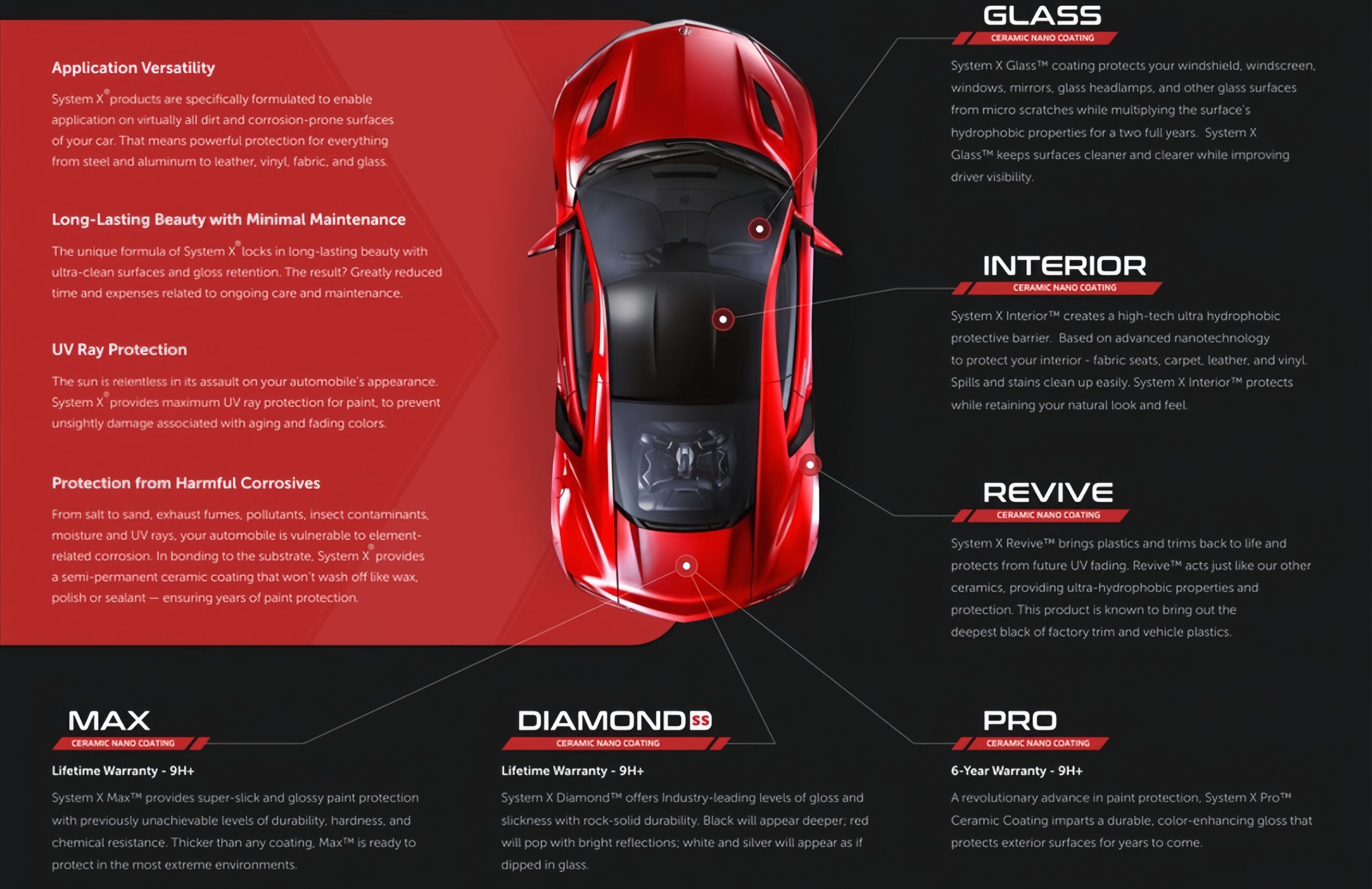
Ceramic coating is an additional protection layer for your car’s exterior, and helps it look brand new with minimal maintenance. The science behind coating is nanotechnology, and due to that, it makes your vehicle more resilient and easier to clean. Here are some other benefits that coating offers:
- Protection from UV damage
- Protection from chemical stains and etching
- Enhanced gloss
- Long-term paint protection for your car
- Hydrophobicity, i.e. water repellence